Family Office Due Diligence Assessment
Family Office Due Diligence Assessment
Evaluating Whether an Organization Can Deliver True Family Office Capabilities
A true family office combines deep expertise, broad capability, and accountable coordination around the family’s long-term objectives.
Not every organization or advisor that uses the words “family office” delivers a full family office experience. Some are excellent specialist firms. Others provide referrals or selected services. A true family office should be evaluated by the depth of its expertise, the breadth of its capabilities, and its ability to integrate, implement, and remain accountable across the family’s full financial and personal life.
Use this assessment if you are already working with an advisor or organization that presents itself as a family office or if you are interviewing a firm and want a practical due diligence framework. Score based on demonstrated evidence, not marketing language.
The Three Legs of a True Family Office
Leg One
Core Advisory Services
Deep technical capability across investment, tax, legal, estate, insurance, banking, philanthropy, and related planning areas
Leg Two
Supporting Services
Governance, next-gen education, risk, reporting, administration, lifestyle, concierge, family facilitation, security and reputation, and legacy support where relevant
Leg Three
Coordination & Integration
One coordinated process that aligns experts, implements decisions, challenges gaps and keeps the burden off the family
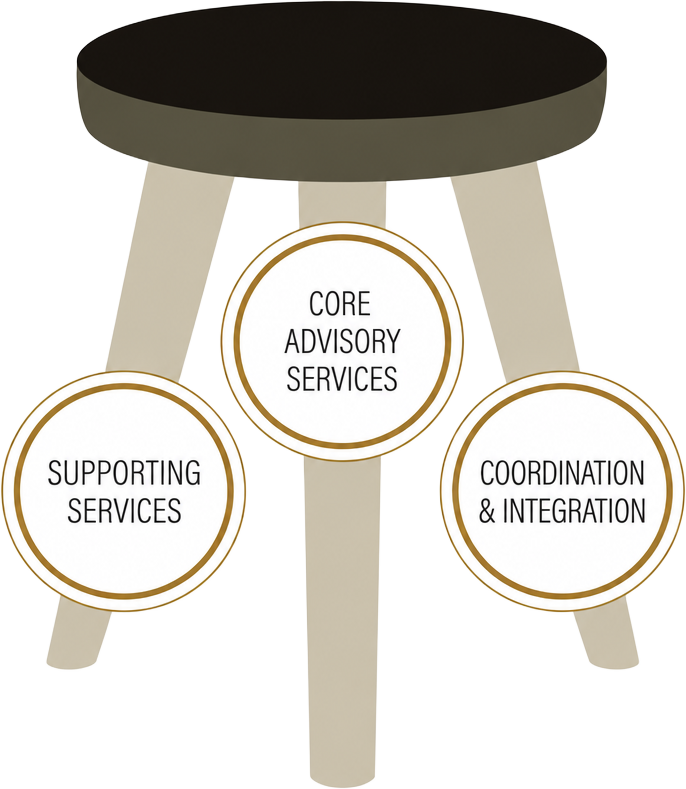
The Three-Legged Stool of a Family Office
Marvin J. Schmidt, 2027 ©
Scoring for the Assessment
0 = Not evident
1 = Limited or mostly referral-based
2 = Meaningful capability but not consistently integrated
3 = Strong capability delivered or coordinated with ownership and accountability
Scoring principle: A high-quality answer should be supported by evidence: team experience, case examples, sample reports, planning calendars, documented processes, and clear accountability.